


- Post author:LauRidMar73
- Post last modified:11 January 2026
- Post category:Non catégorisé
- Reading time:2 mins read
The best emergency braking is the one the motorcyclist avoids. Anticipating the risks as much as possible, riding at a safe speed and maintaining safety margins around the motorcycle greatly reduces the risk of having to brake urgently.
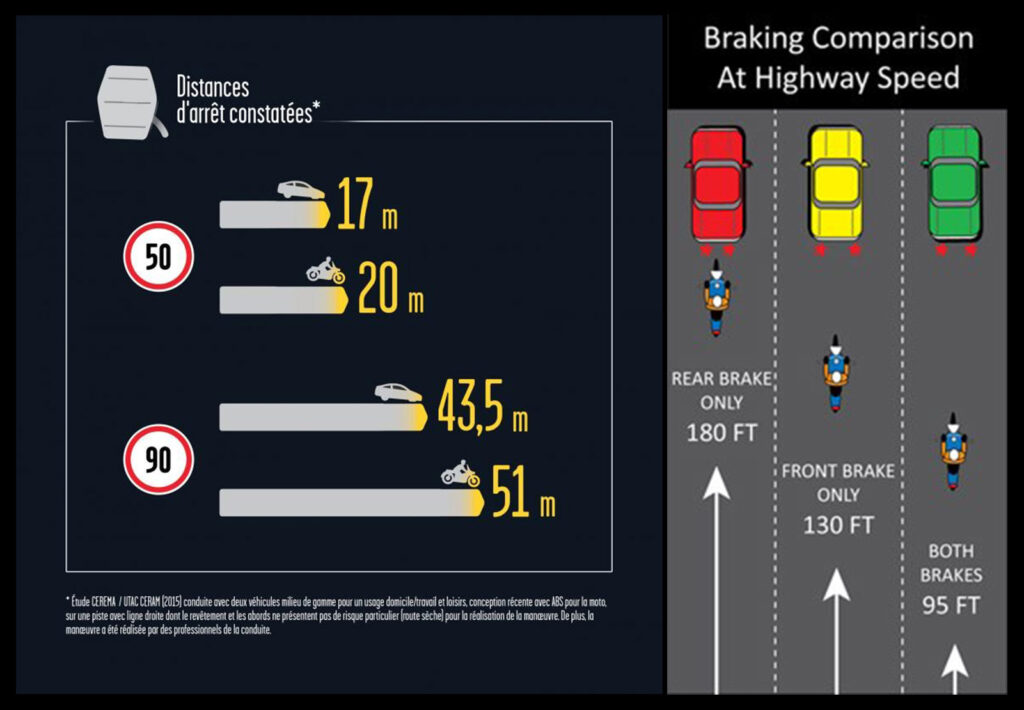
Actions for emergency braking:
1- What to do: Release the throttle grip
For what ? The drop in engine speed is already slowing you down a bit.
2- What to do: Do not downgrade
For what ? You will have to focus all your attention on your braking and avoid complex maneuvers
3- What to do: Do not brake immediately with the front brake
For what ? The effect of engine braking would be reduced, because the rear wheel would touch the ground less.
▶ At high speeds, weight transfer may impair your ability to steer the motorcycle precisely.
4- What to do: Keep your arms relaxed and slightly bent
For what ? You will retain more control of your handlebars than by extending your arms to the maximum.
5- What to do: Then brake using the rear brake to the locking threshold
For what ? The action of the rear brake is added to the slowdown caused by the drop in engine speed.
▶ The front fork sinks less and you keep sight of the obstacle in front of you.
▶ Warning: braking hard from behind is unnatural; it is better to practice
6- What to do: Brake using the front brake without locking the wheel
For what ? The rear braking must be supplemented with the most powerful brake, the front brake. The weight of the bike will inevitably be transferred to the front, but to a lesser extent.
7- What to do: Squeeze the clutch lever
For what ? To stop completely, the motor must stop pushing you. What used to slow you down will continue to push you; this is why the link between the engine and the rear wheel must be cut.
8- What to do: Place one foot or both feet on the ground
For what ? This will allow you to resume a proper driving position and drive off calmly